


Making the Right to Education a Reality
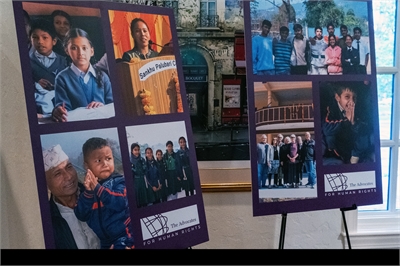
These remarks were delivered by Jennifer Prestholdt, Director of International Advocacy, at our 2026 Spring Nepal School House Party.
Education is widely considered the single most important investment we can make. It's the most important tool we have to lift families out of poverty and level systemic inequality. Yet the fundamental human right to education remains out of reach for many children throughout the world.
The good news is that's not the case at the Sankhu-Palubari Community School in Nepal.
In 1999, in partnership with one small rural community in Nepal, The Advocates founded the Sankhu-Palubari Community School (SPCS) to provide access to free, high-quality education, daily meals, and other essential resources to kids at risk of child labor. The school started small, with a kindergarten class and one teacher in a rented community health building, and added a class every year. From the beginning, there was a focus on gender equality and giving girls the ability to access their right to education.
SPCS has grown to serve 380 students in pre-K through grade 10.
- Students continue to be admitted based on factors that put them at risk of child labor, including their family's low economic status and indigenous or minority status.
- Child labor: Today, there are still an estimated 1.1 million children working in child labor. That's more than 20% of Nepali kids ages 5-14 (which is approx. the age of students at SPCS).
- The agriculture sector accounts for more than 85% of the total child labor in Nepal. SPCS serves kids in a rural, agricultural area in the eastern Kathmandu valley. Some students walk as far as 1 ½ hours each way to go to SPCS. For SPCS students, education is their chance for a better life.
- Right to education: In Nepal, public education at government schools comes with hidden costs (school & exam fees, textbooks, uniform costs, and supplies) that are barriers that keep children from low-income families, such as those who attend SPCS, out of school. For this reason, SPCS is entirely free. In addition, SPCS provides a free daily meal to all students.
- Gender equality: SPCS remains committed to gender parity and giving girls opportunities and the ability to access their right to education. Today, more than 50% of the students are girls. This is important because gender barriers continue to exist for girls in Nepal, particularly in rural areas. While there has been progress in achieving gender parity in primary education in Nepal, there continues to be a higher dropout rate for girls than boys.
Student success: Academic excellence continues at SPCS.
- Last year, 20 students graduated from 10th grade, and all achieved outstanding results on the mandatory national examination. Nationally, only 47% of Nepali 10th-grade students passed this exam, which is required for Nepali students to continue their education through 12th grade.
- In the first week of April, 29 students graduated from 10th grade and sat for the national examinations. They are currently awaiting their results, which we are confident will be exceptional, as in previous years.
- Graduates: By providing completely free, high-quality education, as well as a daily meal, SPCS has made the right to education a reality for more than 1000 graduates. Upon graduation, our students have gone on to pursue careers in civil service, hospitality, engineering, medicine, and a lot of other fields.
- The first girl to graduate from SPCS, is getting a Ph.D. in India. One student is the first SPCS graduate to go to medical school. Other graduates are working in engineering or business. One student, who is of the Tamang indigenous group, didn't speak Nepali or English when he arrived at SPCS as a child, but now he is a teacher and vice principal at SPCS.
Some of you were here when we announced the special fundraising in honor of the 25th anniversary of SPCS. SPCS no longer holds classes in a health post but now is in a beautiful, functional school building. We've now been able to make significant improvements to the school's infrastructure thanks to all of you and your generosity. With your support, we have been able to enhance opportunities for SPCS students to engage in practical, hands-on learning in science and technology:
- Expand the computer lab! Students now learn keyboarding on actual keyboards and have access to the internet.
- Science lab! For the first time, have a new, fully equipped lab with materials and equipment. In addition to these op equipment. In addition to these opportunities for SPCS students to engage in practical, hands-on learning in science and technology:
- Furniture and learning materials for early childhood classrooms! We have enhanced the three pre-primary classrooms, and teachers are excited to begin the new school year in the newly outfitted classrooms. Especially important as access to early childhood education in Nepal is still low, with only 51 percent of kids having opportunity to go to pre-K & kindergarten.
Cost: The Advocates for Human Rights funds SPCS through private donations, and we raise the entire budget every year. It only costs about $300 to educate a child for one year. It's amazing to think that for $300 a year, we can change the life of not only one child but that child's family, breaking the cycle of intergenerational poverty. After 26 years, we can see how human rights in action have really changed the entire community, which now values education for girls as well as boys. SPCS gives students the knowledge, skills, and confidence they need to succeed. Your support helps make that happen.